Note
Go to the end to download the full example code.
Compare Model to Daily MDA8 Observations
Evaluate CAMx by comparing to AirNow or AQS Ozone observations using the 2015 Ozone NAAQS definition of the maximum daily 8-hour average metric.
The basic steps are:
Open CAMx file and identify space/time domain,
Download hourly observations for that domain to a CSV file.
Add CAMx hourly model data to the observations CSV file.
Apply Maximum Daily 8-hour average (Appendix U).
Calculate statistics.
Plot a time series
Reminder: You must have already activated your python environment.
Configuration
# Define Analysis
obssrc = 'airnow'  # or aqs
obsspc = 'ozone'     # or ozone, co, pm25, ...
modsrc = 'CAMx'    # Or CMAQ
modspc = 'O3'     # or O3, CO, PM25, ...

# Set input files
dates = ['20160610', '20160611']
avrgtmpl = '../../camx/outputs/CAMx.v7.32.36.12.{}.avrg.grd02.nc'  # placeholder {} for date

# Outputs
outstem = f'outputs/{obssrc}.{obsspc}_MDA8_and_CAMx.v7.32.36.12.avrg.grd02'
pairedpath = outstem + '.csv'
statspath = outstem + '_stats.csv'
figpath = outstem + '_ts.png'
Imports and Folders
import pyrsig
import pandas as pd
import matplotlib.pyplot as plt
import os

os.makedirs('outputs', exist_ok=True)
Query Observations for Model file
obskey = f'{obssrc}.{obsspc}'  # must exist in RSIG
modkey = f'{modsrc}{modspc}'
keys = [obskey, modkey]
dfs = []
for datestr in ['20160610', '20160611']:
    ncpath = f'../../camx/outputs/CAMx.v7.32.36.12.{datestr}.avrg.grd02.nc'
    ds = pyrsig.open_ioapi(ncpath)
    df = pyrsig.cmaq.pair_rsigcmaq(ds, modspc, obskey, prefix=modsrc, workdir='outputs')
    df[modkey] *= 1000
    df.rename(columns={obsspc: obskey}, inplace=True)
    dfs.append(df)

df = pd.concat(dfs)
Using cached: outputs/airnow.ozone_2016-06-10T000000Z_2016-06-10T235959Z.csv.gz
Using cached: outputs/airnow.ozone_2016-06-11T000000Z_2016-06-11T235959Z.csv.gz
Calculate Hourly Statistics
statsdf = pyrsig.utils.quickstats(df[keys], obskey)
# Save stats to disk
statsdf.to_csv(statspath)
print(statsdf)
       airnow.ozone        CAMxO3
count  29892.000000  29892.000000
mean      38.099505     41.653587
std       19.807133     12.087435
min        0.000000      0.301045
25%       22.665580     33.589913
50%       38.000000     42.133999
75%       53.100000     49.821673
max      115.000000    110.212502
r          1.000000      0.698374
mb         0.000000      3.554083
nmb        0.000000      0.093284
fmb        0.000000      0.089127
ioa        1.000000      0.772703
40 CFR Appendix U to Part 50
3(a) hourly data in LST truncated to ppb precision
3(b) minimum of 6 valid hourly values for an 8h average
3(c) 17 possible valid 8h LST windows per day (07-15 LST, …, 23-07 LST)
3(d) a daily maximum is valid if 13 of 17 possible windows available
https://www.ecfr.gov/current/title-40/chapter-I/subchapter-C/part-50/
Step 3(a): Adjust Times to LST
Get timezone from latitude
Convert tz-aware UTC to tz-naive LST
not truncating
tz = (df.groupby('STATION')['LONGITUDE'].mean() / 15).round(0)
tz = pd.to_timedelta(tz, unit='h')  # EST=-5h, ... PST=-8h
df['time_lst'] = df['time'].dt.tz_convert(None) + tz.loc[df.STATION].values
Step 3(b): Calculate 8h averages
for each site: 1. regularize to hourly data with missing nans 2. create 8h averages only valid when 6 or more available
a8df = df[['STATION', 'time_lst', obskey, modkey]].groupby('STATION').apply(
    lambda sdf:
    sdf.set_index('time_lst')[[obskey, modkey]].asfreq('1h')
    .rolling('8h', min_periods=6).mean(),
    include_groups=True
)
/work/ROMO/users/bhenders/SESARMTraining/examples/mpe/run_mpe_02_o3mda8.py:106: FutureWarning: DataFrameGroupBy.apply operated on the grouping columns. This behavior is deprecated, and in a future version of pandas the grouping columns will be excluded from the operation. Either pass `include_groups=False` to exclude the groupings or explicitly select the grouping columns after groupby to silence this warning.
  a8df = df[['STATION', 'time_lst', obskey, modkey]].groupby('STATION').apply(
Step 3(c): Calculate 8h averages
Pandas labels 8h means based on start time in LST 1. regularize to hourly data with missing nans 2. remove 00-06 LST hours that duplicate previous day’s hours
# pandas labels the first 8h average (hours 00-07) as 07, so decrement
# the start_time_lst hour by 7h to match starting time
iddf = a8df.index.to_frame()
iddf['start_time_lst'] = iddf['time_lst'] + pd.to_timedelta('-7h')
a8df.index = pd.MultiIndex.from_frame(iddf[['STATION', 'start_time_lst']])
# Valid if 13 of 17 possible valid windows (07-15 LST, ..., 23-07 LST)
# Remove the 8h averages starting 00-06 LST
n = a8df.shape[0]
a8df.query('start_time_lst.dt.hour > 6', inplace=True)
nnew = a8df.shape[0]
print(f'INFO:: removed {n - nnew} ({1 - nnew / n:.2%}) 8h avg (7 morning hours)')
INFO:: removed 8954 (29.19%) 8h avg (7 morning hours)
Step 3(d): Calculate daily maxima
For each STATION, - get the max 8h average within a local standard day - remove when fewer than 13 available
mda8df = a8df.groupby(['STATION', pd.Grouper(level='start_time_lst', freq='24h')]).agg(**{
    obskey: (obskey, 'max'),
    modkey: (modkey, 'max'),
    'count': (obskey, 'count')
})
n = mda8df.shape[0]
mda8df.query('count >= 13', inplace=True)
nnew = mda8df.shape[0]
print(f'INFO:: removed {n - nnew} ({1 - nnew / n:.2%}) MDA8 values (less than 13 8h avgs)')
mda8df['COUNTYFP'] = mda8df.index.to_frame()['STATION'].astype(str).str[:5]
mda8df.to_csv(pairedpath)
INFO:: removed 1320 (68.75%) MDA8 values (less than 13 8h avgs)
Calculate MDA8 Statistics
statsdf = pyrsig.utils.quickstats(mda8df[keys], obskey)
# Save stats to disk
statsdf.to_csv(statspath)
# Print them for the user to review.
print(statsdf)
       airnow.ozone      CAMxO3
count    600.000000  600.000000
mean      52.517737   51.605904
std       17.265956   11.977870
min       13.462500   24.430573
25%       41.718750   44.530444
50%       55.906250   53.408267
75%       64.856250   59.050945
max      105.625000   99.977543
r          1.000000    0.868137
mb         0.000000   -0.911833
nmb        0.000000   -0.017362
fmb        0.000000   -0.017514
ioa        1.000000    0.897360
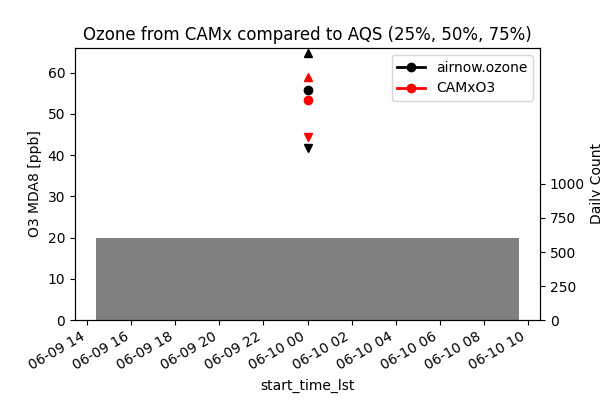
Visualize Results
gb = mda8df.groupby('start_time_lst')[keys]
cntdf = gb.count().reset_index()

fig, ax = plt.subplots(figsize=(6, 4))
tax = ax.twinx()
x = cntdf['start_time_lst'].to_numpy()
tax.bar(x=x, height=cntdf[modkey], color='pink')
tax.bar(x=x, height=cntdf[obskey], color='grey')
gb.median().plot(color=['k', 'r'], linewidth=2, zorder=2, ax=ax, marker='o')
gb.quantile(.75).plot(ax=ax, color=['k', 'r'], linestyle='--', legend=False, zorder=1, marker='^')
gb.quantile(.25).plot(ax=ax, color=['k', 'r'], linestyle='--', legend=False, zorder=1, marker='v')
tax.set(zorder=0, facecolor='w', ylim=(0, 2000), yticks=[0, 250, 500, 750, 1000])
tax.set(ylabel='Daily Count')
ax.set(zorder=1, facecolor='none', ylim=(0, None), ylabel='O3 MDA8 [ppb]')
ax.set(title='Ozone from CAMx compared to AQS (25%, 50%, 75%)')
fig.savefig(figpath)
Extra Credit
Modify the script to evaulate 1-hour maximum hourly ozone.
Modify the script to evaluate W126.
Total running time of the script: (0 minutes 5.288 seconds)